Archive for April, 2020

Fools, Sluggards and Talebearers

There are three big topics that this chapter covers. Instead of a deep dive into a single thought, I want to show some verses about each topic and make a few comments.

Fools

1 As snow in summer, and as rain in harvest, so honour is not seemly for a fool.

2 As the bird by wandering, as the swallow by flying, so the curse causeless shall not come.

3 A whip for the horse, a bridle for the ass, and a rod for the fool’s back.

4 Answer not a fool according to his folly, lest thou also be like unto him.

5 Answer a fool according to his folly, lest he be wise in his own conceit.

6 He that sendeth a message by the hand of a fool cutteth off the feet, and drinketh damage.

7 The legs of the lame are not equal: so is a parable in the mouth of fools.

8 As he that bindeth a stone in a sling, so is he that giveth honour to a fool.

9 As a thorn goeth up into the hand of a drunkard, so is a parable in the mouths of fools.

10 The great God that formed all things both rewardeth the fool, and rewardeth transgressors.

11 As a dog returneth to his vomit, so a fool returneth to his folly.

12 Seest thou a man wise in his own conceit? there is more hope of a fool than of him.

Proverbs 26:1-12

The word translated fool could also be translated as dullard, silly, arrogant one. However, in the King James Bible all 70 uses of this Hebrew word are translated as fool or foolish.

It is incongruous for a fool to receive honor (v. 1, 8) or have a bit of wisdom to share (v. 7, 9). Fools are not to be trusted (v. 6). They have more confidence in themselves than they should (v. 4, 5, 12). And, this passage about the actions of a fool gives us the one verse that was easiest for me to memorize as a grade-schooler (v. 11). What 12-year-old boy doesn’t love talking about puke?

Sluggards

13 The slothful man saith, There is a lion in the way; a lion is in the streets.

14 As the door turneth upon his hinges, so doth the slothful upon his bed.

15 The slothful hideth his hand in his bosom; it grieveth him to bring it again to his mouth.

16 The sluggard is wiser in his own conceit than seven men that can render a reason.

Proverbs 26:13-16

Slothful can be translated as sluggish, lazy or sluggard (one who is sluggish). With one exception, this word is found exclusively in Proverbs and is always translated as sluggard and slothful. The only other time it is used is Judges 18:9 and is also translated slothful.

Verse 13 speaks of not wanting to do something because of a potential danger. Certainly, if there were an actual lion in the street outside the front of my house, I would not want to go out either. But, based this comment being viewed as a bad thing, I think Solomon is talking about a potential lion or danger that may not be actual. The sluggard is looking for an excuse to stay home and do nothing.

His laziness keeps him in bed. His tossing to and fro in the bed is like a revolving door (v. 14). He’s even so lazy that he doesn’t eat (v. 15). He can make up excuses so fast for why he’s not working that it will make your head spin (v. 16).

Possible Depression

This is being attributed to laziness, which I think is the primary point and needs to be addressed. But allow me to mention something else that this behavior might be a sign of: depression. There is help for depression. Let me encourage you to seek help for yourself or for others who may need it.

Don’t use depression as an excuse for laziness. On the other hand, don’t blame laziness for legitimate depression. The point is, you can get help for both. You might need external help to work through laziness or depression. I don’t mean to imply they are the same thing, they are not. But they often have the similar symptoms.

If you are needing help, talk with your pastor and get a recommendation for someone in your area who can help you with either or both.

Talebearers

The rest of the chapter deals with those who would stir up strife. The word here is talebearer, but it means a whisperer, murmurer or slanderer. Sometimes these talebearers pick a fight because of perceived conflict, but sometimes they do it for the fun of making others uncomfortable. Here are a few verses from the rest of the chapter.

Mind Your Own Business

17 He that passeth by, and meddleth with strife belonging not to him, is like one that taketh a dog by the ears.

Proverbs 26:17

If you yank on a dogs ears, he will likely retaliate. If this isn’t your fight, stay out of it. Don’t jump into conflict that isn’t yours.

I will grant, that sometimes it is worth having to fight the dog for the purpose of saving someone else from the fight. This verse doesn’t say you should never jump to the aid of someone who needs it, but you should probably size up the dog before you start yanking ears.

You Are the Only One Who Thinks It’s Fun

18 As a mad man who casteth firebrands, arrows, and death, 19 So is the man that deceiveth his neighbour, and saith, Am not I in sport?

Proverbs 26:18, 19

I know some people who like to create conflict for the entertainment value. Getting people riled up “for the fun of it” is only fun for the one causing the needless conflict. No one likes it except you. Please stop.

I was in a conversation recently where someone jumped in just to say a few words to try to make another person upset. The instigator was disappointed when the person they were attacking didn’t attack back. This time it was done in jest, but that can’t be an enjoyable environment to have to deal with all the time.

No Fuel = No Fire

20 Where no wood is, there the fire goeth out: so where there is no talebearer, the strife ceaseth.

21 As coals are to burning coals, and wood to fire; so is a contentious man to kindle strife.

Proverbs 26:20, 21

You can be the one to quench a flame. You don’t have to retaliate just because someone says something negative to you. They may have brought the fire, but if you don’t give them wood to work with, the fire dies pretty quickly. That’s what happened in my recent conversation that I mentioned above: the person did not play into the game of attacking back.

Sticks, Stones and Words That Hurt

22 The words of a talebearer are as wounds, and they go down into the innermost parts of the belly.

Proverbs 26:22

It is not true that “sticks and stones may break my bones, but words will never hurt me.” Even as an adult—or maybe, especially as an adult—we find that damaging words can destroy relationships for a lifetime.

I have a couple of odd friendships (probably many of us do). I am friends with two people who hate each other. I can maintain a good relationship with both sides because neither one has offended me personally. Their words have not wounded me. As much as I may want them to be friends again, they have inflicted deep wounds on one another; wounds that neither side is willing to let heal on this side of eternity. All because of words.

Be careful of your words. Be diligent in your work. Be mindful of your self-centered foolishness.
Be Curious

It is the glory of God to conceal a thing: but the honour of kings is to search out a matter.

Proverbs 25:2

My first understanding of the word curiosity came from a tailless monkey and a man with a yellow hat. You probably had a similar experience reading the Curious George books as a child. And, it was made clear to us children, that curiosity could only lead to trouble.

Then we hear the oft-used phrase, “curiosity killed the cat.” To which I like to reply, “yes, but satisfaction brought him back.”

Certainly there are times when a person can be inappropriately curious; a.k.a., nosy. But, for the most part, I think curiosity is something that we should be encouraged to develop.

Curiosity is Not Bad, It is Glorious

Solomon tells us here in Proverbs 25:2 that it is honorable to be curious. What I found interesting about this verse are the actual words used in Hebrew. English has translated the verse to be more poetic, but it is actually very symmetric in the original language (like much of Psalms and Proverbs are).

In the verse, the words glory and honor are the same word in Hebrew. And the words thing and matter are identical to one another.

It is glorious to God to hide or to conceal something and it is glorious to man to discover it. God takes pleasure and glory in hiding stuff in creation for us to find. And, it is a pleasure for people to discover what God has hidden.

Easter Egg Hunt

If you have taken part of an Easter Egg hunt, you know that it can be fun whether you are the one doing the hiding or the finding. There is pleasure in both aspects of the hunt.

The adult version of that game would be Geocaching. There are thousands of little boxes (caches) hidden around the world that people put out so that others can have the joy of finding them.

I think this is the meaning of what Solomon is teaching. God gets pleasure, enjoyment, even honor from His work of hiding things for us to discover. And, we can derive great joy from discovering God’s creation.

You Don’t Have to be First

Have you heard about the Wright brothers’ most well-funded competitor, Samuel Pierpont Langley? The name may be familiar, but that he was involved with trying to be first in powered flight might be unknown to you. He did do some great work in the realm of flight, but he also largely gave up once the Wright brothers accomplished powered flight.

But the joy of discovery or invention can be enjoyed by more than one person. Of course, most of us aren’t trying to accomplish the same type of work the Wright brothers did, but we can still enjoy the process of learning something new through the process of discovery.

Whether you understand the math in this video or not, the message of the joy of discovery is the main point.

Don’t Let the World Kill Your Curiosity

Albert Einstein was an insatiably curious man. He talked or wrote about it several times. In an essay called The World As I See It, Einstein talks of wonder and awe. He said, “Whoever does not [experience the mysterious] and can no longer wonder, no longer marvel, is as good as dead, and his eyes are dimmed.” He wrote something similar for an anthology called Living Philosophies.

It baffles me to talk with people who seem to have no curiosity to learn new things. I have a vast domain of curiosity (maybe too much). Not everyone has to inspect every rabbit hole, or chase every squirrel they see like I seem to have to do, but I think everyone should have some sense of wonder and desire to discover new things. Otherwise, God’s glory and man’s honor never get put on display.

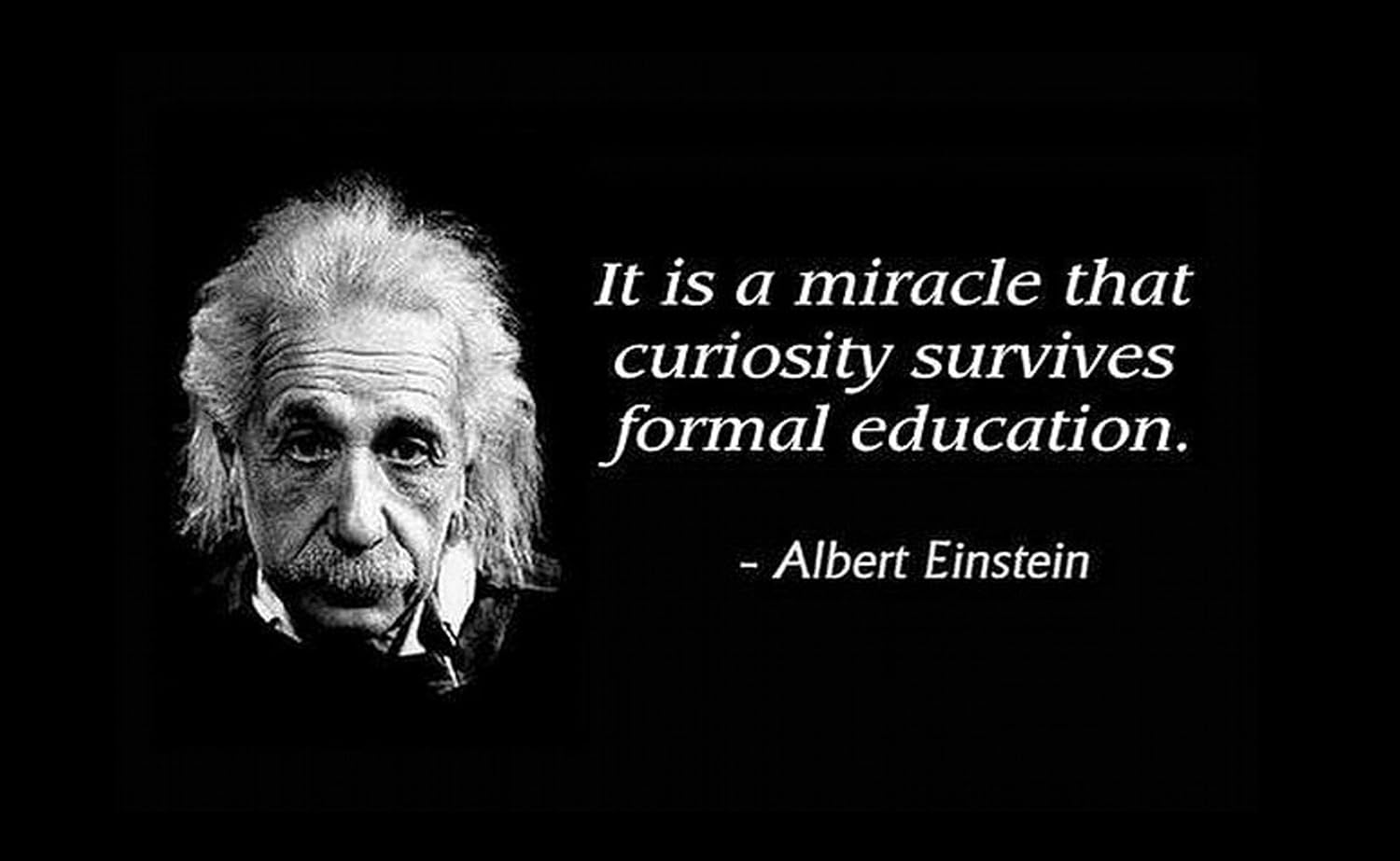
Another quote by Einstein (which is put more pithily in the following poster) is, “It is nothing short of a miracle that modern methods of instruction have not yet entirely strangled the holy curiosity of inquiry.”

Poster on Amazon

I like this quote because it takes a jab at one of my favorite institutions to poke fun at: school. I think that much of our curiosity is stifled in the classroom. We are told what to study and when to study it.

It seems ironic to me that a person is not allowed to get excited about a topic to study on their own until they finally get out of formal educational institutions. In school there is very little room for a person to go off script and become passionate about a topic because there are test schedules to keep.

Take pleasure in the joy of discovery. Be curious about the world around you; even if the man in the yellow hat tries to tell you otherwise.

Don’t Envy the Wicked

1 Be not thou envious against evil men, neither desire to be with them. 2 For their heart studieth destruction, and their lips talk of mischief.

19 Fret not thyself because of evil men, neither be thou envious at the wicked: 20 For there shall be no reward to the evil man; the candle of the wicked shall be put out.

Proverbs 24:1, 2, 19, 20

Advantage of Getting Older

As we get older I think there are some things that make a whole lot more sense than they did when we were younger. The idea we see in these verses is one of those things that gets clearer to me with age: the wicked do not prosper.

A few weeks ago I was thinking along the same lines as these verses but hadn’t remembered that Proverbs covered this topic so clearly. I was thinking about how, as a younger person, I wondered what certain activities would be like. How fun and satisfying certain sins must be. Thankfully, I was spared from too much experimentation. Though, I can’t say I avoided everything that could have brought on great tragedy in my life.

Solomon tells us that we should not be jealous of people who seem to be enjoying their sinful lifestyle. The result of their sin is destruction.

Temporal or Eternal?

I don’t know that Solomon was thinking in the realm of eternity when he wrote these verses. He may have been writing only about the mortal life of the sinner. This is certainly what I was thinking a few weeks ago: the consequences of sin and how they affect this life.

Even someone who has put their faith and trust in Jesus Christ as Savior can fall into sin that results in tragedy and sadness. If you know, or suspect, that something is wrong, then just don’t do it. There is nothing good that can come from violating your own conscience and upbringing.

How Do I Know What is Right?

What Mom and Dad Taught

First, I would go back to what you were taught as a child. If your parents said you shouldn’t do it, then it is safe to assume that it is probably wrong. Certainly not all parents are correct in their morals nor do they all know what the Bible teaches, but they generally want to steer their children in the right way.

Of course, there are some things that are wrong for a 10 year old that is not wrong for a 25 year old. But generally, the good behavior and manners you were taught as a child is a good starting point for appropriate behavior.

Authority of the Bible

Secondly, I would go to the authority of the Bible. If the Bible touches on a topic in a clear way, then that should settle any questions for you.

“But, I don’t believe the Bible is the final authority.” Even if you don’t think the Bible is God’s authoritative Word, here are some results of living by the principles of the Bible: sober lifestyle that is out from under the control of external substances (drugs, alcohol, etc.), having a good relationship with your spouse, living in harmony with your neighbors, being honest with and forgiving to those around you. I think most people would be glad to look back on a life like that instead of bar fights, constant squabbling, loss of a child because of driving under the influence, prison time, or a host of other sad consequences to sin.

Biblical Principles

Thirdly, there are some activities that may not have any clear teaching in the Bible, and they are things your parents didn’t teach you about. There are some clear principles of decision making that can help in those instances.

Observing the Results

Finally, be observant of the wicked and the consequences of their choices. Solomon says not to be jealous of their lifestyle. If something is wrong, no matter how the world tries to dress it up and sell it on TV commercials, you should avoid getting involved with that sin.

17 Let not thine heart envy sinners: but be thou in the fear of the Lord all the day long.

Proverbs 23:17

Wounds Without Cause

29 Who hath woe? who hath sorrow? who hath contentions? who hath babbling? who hath wounds without cause? who hath redness of eyes?

30 They that tarry long at the wine; they that go to seek mixed wine.

31 Look not thou upon the wine when it is red, when it giveth his colour in the cup, when it moveth itself aright.

32 At the last it biteth like a serpent, and stingeth like an adder.

33 Thine eyes shall behold strange women, and thine heart shall utter perverse things.

34 Yea, thou shalt be as he that lieth down in the midst of the sea, or as he that lieth upon the top of a mast.

35 They have stricken me, shalt thou say, and I was not sick; they have beaten me, and I felt it not: when shall I awake? I will seek it yet again.

Proverbs 23:29-35

This isn’t about whether it is permissible for a Christian to drink alcohol. These verses make a clear argument that it isn’t wise to let it have control in your life.

And it will never have control if you never give it any space to do so.

Why would someone willingly welcome wounds without cause? Or open the door to unnecessary sorrow? Or invite contention into the family?

There is nothing of lasting value that alcohol can bring to your life. There is no loss in avoiding it. Therefore, the wise choice is to just walk away from it and never give it a chance to take control.

Read Your Own Mail

Train up a child in the way he should go: and when he is old, he will not depart from it.

Proverbs 22:6

I have heard much debate on whether this verse is a promise or a principle. I assure you at the start, I probably won’t definitively clear that up for you in this post. But I do think we can learn something from the concept of the debate.

I think the question stems from uncertainty as to whether my actions can change someone else’s response and actions. I can’t be the Holy Spirit for someone else. However, I have power over my own decisions and actions. Therefore, I should do what is right regardless of how someone else may or may not respond.

Unfair Commands

This verse is a good launchpad for us to learn about one-sided commands. In other words, statements (or commands) that I am supposed to apply to me but that don’t take into account another person’s free will to do as they please.

The post from a couple of days ago that I titled Driving a Hard Bargain is an example of one of these types of statements. In the marketplace we are supposed to treat people fairly even if they don’t treat us fairly. Does this seem fair? That is the type of command I am talking about.

More Examples

In Ephesians five and six there are commands to husbands, wives, parents and children. Husbands are to love their wives. Wives are to submit to their husbands. Children are to obey their parents. And parents are not to provoke their children to wrath (not to frustrate them) while raising them in a loving, Christian environment.

If my wife does not submit, does that mean I don’t have to love her? Or if my children don’t obey, I am no longer under the obligation to raise them in a loving way? No!

This is where we need to see the command that is given to us (whichever person in the family we are) and live in obedience to that regardless of whether others in the family are doing their part. Don’t make your obedience to God contingent on whether other people obey the commands given to them.

Reading Your Own Mail

As a husband I should focus on what is written to me. When I love my wife, it makes it easier for her to submit. But I should love her whether she submits or not. And, as a wife, her obedience to God’s command is submission, whether I love her or not. Again, it is much easier for her to do her part if I do mine. And, it is easier for me to do my part if she does hers. However, I should not make my obedience to God’s command based on whether other people are also obeying.

My responsibility is to obey the part written to me.

This is what I call “reading your own mail.” Read what is written to you. As a child, I should obey my parents because it is commanded for me to obey. The command does not say, “you only need to obey if your parents are loving and promise to give you a car when you turn 16.”

Gentle Aside: Parents, it is a dangerous thing to constantly promise some type of reward for obedience. They should obey because God told them to, not because they will get a treat for being good. Giving them treats is not wrong. But you should be the ones training them, not allowing them to train you into giving them something in exchange for obedience.

Principle or Promise?

I have dear friends who struggle with the decisions their adult children are making. Dad and Mom have been faithful in the ministry God has called them to. They are heartbroken because they, understandably, want to hold onto Proverbs 22:6 as a promise. But their children are making decisions that have departed far from the path they were taught. How do you comfort them?

In a perfect world, with perfect parents and perfect children, I believe this verse is an ironclad promise. If I always trained my children perfectly in accordance to God’s leading and there were no outside influences to pull my child off path, then this is a promise I could rest upon.

But we don’t live in a perfect world. My children are pretty good kids, but they aren’t perfect. I know I haven’t always been the best example of a biblically obedient parent. And, no matter how much we may try to protect our children, they are influenced by their peers and the worldly media that reaches them.

This is certainly not an argument for never letting your children outside the home. Or, for signing them up for a monastery or convent the day they turn 12. The argument is for you to also look at the principle behind the verse.

If I, as a parent, will train my child in the ways of the Lord when they are young, it will be very hard for them to go astray from that. If they do go astray it will be in conscientious disobedience to God.

Another Aside: For my animal husbandry friends, this word train is interesting to me. It is from a word that filtered into many other languages that is used for what we would call today, imprinting.

I don’t know all the ins and outs of how psychology uses the term imprinting, but in the animal world it is used to help the new baby animal learn about the world. You do things to them—like stick your finger in their mouth and nostrils—to help them think that being handled in this way is a normal occurrence. Then, when you have to administer medicine later, they won’t be surprised by it.

The word translated train, morphed into other languages meaning the jaws, palate and neck. It can mean to taste, to put something in the mouth. Metaphorically it can mean to understand.

The Point

Whether this verse in Proverbs is a promise or principle is not the point today. My point is that I should do my part whether the other person does theirs or not.

Approach the Bible with the thought that, “I will do what I am commanded to do whether other people live in obedience to that or not.” When God gives a statement that should be obeyed, I need to look and see if it is written to me. Is it my mail? If it is, then I should read it and heed it.

If what is written is not for me, then I need to accept that others must make their own choice as to whether or not they will obey. I do not need to be the one to force them to obey. That is not to say that I can’t teach others what is right. Especially in the home, parents are told to teach God’s commands (Deuteronomy 6:1-9).

There are situations where it is appropriate to train others in how to obey God. And, in some situations, God has authorized you and me with the responsibility to carry out the punishment for someone’s disobedience. But, our obedience to His Word is not based on their obedience.

We must read the mail that is written for us. Then we should obey it because it is right to obey. Don’t base your obedience on the obedience of others.

 Page 1 of 6  1  2  3  4  5 » ...  Last »