I recently posted the text of John Bunyan’s trial before Judge Wingate. In this trial Bunyan explained his thoughts on various subjects. Here are his thoughts on freedom of religion.

JUDGE WINGATE: This Court would remind you, sir, that we are not here to debate the merits of the law. We are here to determine it you are, in fact, guilty of violating it.

BUNYAN: Perhaps, M’lord, that is why you are here, but it is most certainly not why I am here. I am here because you compel me to be here. All I ask is to be left alone to preach and to teach as God directs me. As, however, I must be here, I cannot fail to use these circumstances as an opportunity to speak against what I know to be an unjust and odious edict.

JUDGE WINGATE: Let me understand you. You are arguing that every man has a right, given him by Almighty God, to seek the Deity in his own way, even, if he chooses, without benefit of the English Church?

BUNYAN: That is precisely what I am arguing, M’lord. Or without benefit of any church.

JUDGE WINGATE: Do you know what you are saying? What of Papists and Quakers? What of pagan Mohammedans? Have these the right to seek God in their own misguided way?

BUNYAN: Even these M’lord.

JUDGE WINGATE: May I ask if you are particularly sympathetic to the views of these or other such deviant religious societies?

BUNYAN: I am not, M’lord.

JUDGE WINGATE: Yet you affirm a God-given right to hold any alien religious doctrine that appeals to the warped minds of men?

BUNYAN: I do, M’lord.

JUDGE WINGATE: I find your views impossible of belief. And what of those who, if left to their own devices, would have no interest in things heavenly? Have they the right to be allowed to continue unmolested in their error?

BUNYAN: It is my fervent belief that they do, M’lord.

JUDGE WINGATE: And on what basis, might I ask, can you make such a rash affirmation?

BUNYAN: On the basis, M’lord, that a man’s religious views—or lack of them—are matters between his conscience and his God, and are not the business of the Crown, the Parliament, or even, with all due respect, M’lord, of the Court.

However much I may be in disagreement with another man’s sincerely held religious beliefs, neither I nor any other may disallow his right to hold those beliefs. No man’s rights in these affairs are secure if every other man’s rights are not equally secure.

JUDGE WINGATE: It is obvious, sir, that you are a victim of deranged thinking. If my ears deceive me not, I must infer from your words that you believe the State to have no interest in the religious life of its subjects.

BUNYAN: The State, M’lord, may have an interest in anything in which it wishes to have an interest. But the State has no right whatever to interfere in the religious life of its citizens.

[After this Judge Wingate steers the conversation to the extent of Bunyan’s formal education.]

Bunyan argued that people should be free to worship God in any way they pleased. That would extend to people who chose to not worship God at all. While it seems odd for a Christian man to argue that we should be free to choose to worship in any way we feel proper, it really is in keeping with Christian belief.

When religion is mandated, then the option for one to have a personal relationship with God is devalued. God has given us a free will. With that freedom comes the freedom to choose whether we would love God or not. God even gives us the choice as to whether we even believe He exists or not.

When governments step in and mandate any particular religion then they are taking away the freedom of choice God has granted us. Even if the government requires us to “believe” in what we believe to be the right and true religion, it then becomes a matter of duty or obligation to believe in God. It then is no longer a personal relationship with a personal God.

I explained this passage to a friend of mine who is a baby Christian. He comes from a Catholic background and would call himself a patriot to the United States. My friend was incensed at the thought that Bunyan made concessions for Catholics and Muslims to worship God on their own terms. However, I think you have to agree that if you don’t allow for freedom of all religions, then you really have no freedom for any religion.

From the simple words of John Bunyan we can see such deep truth.

John Bunyan’s Trial – The Breedlove Papers

Last night I read once again the Breedlove Papers as they relate to the trial of John Bunyan. The simplicity with which Bunyan answered the judge is both refreshing and profound. John Bunyan was an uneducated man who had a deep love for God and His Word. He represented himself at his own trial where he was judged and sentenced for preaching without a license from the English government.

This is the transcript as recorded by Thomas Breedlove. Breedlove was a legal scribe who provided the word for word transcripts from the trials he was assigned. These trails numbered nearly 1000 between the years 1660 to 1675.

John Bunyan was the author of the beloved Christian allegory The Pilgrim’s Progress. While the language may be hard to grasp at first, it really is worth reading. You may need to keep a dictionary close or read one of the more modernized English versions of the book. This great book was written when Bunyan was in prison following this trial.


PROCEEDINGS, being a true account of the trial of John Bunyan, Tinker, of Bedfordshire, His Lordship, Judge Wingate presiding at the Courthouse in Bedfordshire on October 3, in the Year of our Lord, 1660. The Accused is charged with willful and deliberate Violation of various and sundry Royal and Parliamentary Edicts. His Trial this Day, however, respects a single Charge: namely, Violation of the Conventicle Act, first proposed by Her Most High and Mighty Majesty, our Late Beloved Queen Elizabeth, and reinstated by His Beneficent Highness, King Charles II. All Parties being in Place, and the Witnesses having been sworn, the trial proceeds.

JUDGE WINGATE: Mr. Bunyan, you stand before this Court accused of persistent and willful transgression of the Conventicle Act, which prohibits all British subjects from absenting themselves from worship in the Church of England, and from conducting worship services apart from our Church. You come, presumably, with no legal training, and yet without counsel. I must warn you, sir, of the gravity of the charge, the harshness of the penalty, in the event of your conviction, and the foolhardiness of acting as your own counsel in so serious a matter. Are you cognizant of these facts, and do you understand the charge?

BUNYAN: I am, and I do, M’lord.

JUDGE WINGATE: In truth, I hope you do. Now, I hold in my hand the depositions of the witness against you. In each case, they have testified that, to their knowledge, you have never, in your adult life, attended services in the church of this parish. Each further testifies that he has observed you, on numerous occasions, conducting religious exercises in and near Bedford. These depositions have been read to you, have they not?

Sketch of John Bunyan

BUNYAN: They have, M’lord.

JUDGE WINGATE: In that case, then, this court would be profoundly interested in your response to them.

BUNYAN: Thank you M’lord. And may I say that I am grateful for the opportunity to respond. Firstly, the depositions speak the truth. I have never attended services in the Church of England, nor do I intend ever to do so. Secondly, it is no secret that I preach the word of God whenever, wherever, and to whomever He pleases to grant me opportunity to do so.

Having said that, M’lord, there is a weightier issue that I am constrained to address. I have no choice but to acknowledge my awareness of the law which I am accused of transgressing. Likewise, I have no choice but to confess my guilt in my transgression of it. As true as these things are, I must affirm that I neither regret breaking the law, nor repent of having broken it. Further, I must warn you that I have no intention in future of conforming to it. It is, on its face, an unjust law, a law against which honorable men cannot shrink from protesting. In truth, M’lord, it violates an infinitely higher law—the right of every man to seek God in his own way, unhindered by any temporal power. That, M’lord, is my response.

JUDGE WINGATE: This Court would remind you, sir, that we are not here to debate the merits of the law. We are here to determine it you are, in fact, guilty of violating it.

BUNYAN: Perhaps, M’lord, that is why you are here, but it is most certainly not why I am here. I am here because you compel me to be here. All I ask is to be left alone to preach and to teach as God directs me. As, however, I must be here, I cannot fail to use these circumstances as an opportunity to speak against what I know to be an unjust and odious edict.

JUDGE WINGATE: Let me understand you. You are arguing that every man has a right, given him by Almighty God, to seek the Deity in his own way, even, if he chooses, without benefit of the English Church?

BUNYAN: That is precisely what I am arguing, M’lord. Or without benefit of any church.

JUDGE WINGATE: Do you know what you are saying? What of Papists and Quakers? What of pagan Mohammedans? Have these the right to seek God in their own misguided way?

BUNYAN: Even these M’lord.

JUDGE WINGATE: May I ask if you are particularly sympathetic to the views of these or other such deviant religious societies?

BUNYAN: I am not, M’lord.

JUDGE WINGATE: Yet you affirm a God-given right to hold any alien religious doctrine that appeals to the warped minds of men?

BUNYAN: I do, M’lord.

JUDGE WINGATE: I find your views impossible of belief. And what of those who, if left to their own devices, would have no interest in things heavenly? Have they the right to be allowed to continue unmolested in their error?

BUNYAN: It is my fervent belief that they do, M’lord.

JUDGE WINGATE: And on what basis, might I ask, can you make such a rash affirmation?

BUNYAN: On the basis, M’lord, that a man’s religious views—or lack of them—are matters between his conscience and his God, and are not the business of the Crown, the Parliament, or even, with all due respect, M’lord, of the Court.

However much I may be in disagreement with another man’s sincerely held religious beliefs, neither I nor any other may disallow his right to hold those beliefs. No man’s rights in these affairs are secure if every other man’s rights are not equally secure.

JUDGE WINGATE: It is obvious, sir, that you are a victim of deranged thinking. If my ears deceive me not, I must infer from your words that you believe the State to have no interest in the religious life of its subjects.

BUNYAN: The State, M’lord, may have an interest in anything in which it wishes to have an interest. But the State has no right whatever to interfere in the religious life of its citizens.

JUDGE WINGATE: You are a tinker by trade, are you not, Mr. Bunyan?

BUNYAN: That is correct, M’lord.

JUDGE WINGATE: Would you mind apprising this Court of the extent of your formal schooling?

BUNYAN: Not at all, M’lord. Able I am to read and write, and that with difficulty.

JUDGE WINGATE: I surmised as much. I think I perceive why you are unable to appreciate the disaster that would accompany your views should ever they hold sway in our society. I myself—and I say this in all modesty—am not inconsiderably trained in the historian’s discipline. If you were half so well-versed yourself, you would instantly recognize the fatal flaw in your reasoning. Throughout history, virtually every significant human tragedy has come about as a result of divergent religious views. Nation against nation. Brother against brother. War. Destruction. Devastation. Time and time again. And why? I shall tell your why, sir. It is because men cannot agree on which God to worship, and how to worship Him.

Now, after a long and arduous struggle, we have succeeded in forging a conformity in the religious beliefs of all Englishmen. All our problems will be resolved when everyone finally agrees to accommodate himself, and adopt the same orthodoxy of religious opinion. No more religious wars! No more divisive doctrinal disputes! Think of it, Mr. Bunyan! Does this not portend a society of which any man would be proud and happy to be a part?

BUNYAN: To a degree, M’lord, it admittedly does. But only if everyone can be convicted by virtue of reasoning alone to adopt identical views of God. The society that you describe is an appealing one, but I fear the cost is far too high. It would necessitate that honest men repudiate convictions honestly held.

JUDGE WINGATE: You are, Mr. Bunyan, a strong-willed and opinionated man. Yet, this Court finds it fascinating to speak with you, and wishes, time permitted, further discussion of our respective philosophies. But, alas, time is passing swiftly, and other cases await our attention. Let us move, then, to the matter before us, shall we? The evidence I hold in my hand—even apart from your own admission of guilt—is sufficient to convict you, and the Court is within its right to have you committed to prison for a considerably long time. I do not wish to send you to prison, Mr. Bunyan. I am aware of the poverty of your family, and I believe you have a little daughter who, unfortunately, was born blind. Is this not so?

BUNYAN: It is, M’lord.

JUDGE WINGATE: Very well. The decision of the Court is this: Inasmuch as the accused has confessed his guilt, we shall follow a merciful and compassionate course of action. We shall release him on the condition that he swear solemnly to discontinue the convening of religious meetings, and that he affix his signature to such an oath prior to quitting the Courtroom. That will be all, Mr. Bunyan. I hope not to see you here again. May we hear the next case?

BUNYAN: M’lord, if I may have another moment of the Court’s time?

JUDGE WINGATE: Yes, but you must be quick about it. We have other matters to attend to. What is it?

BUNYAN: I cannot do what you ask of me, M’lord. I cannot place my signature upon any document in which I promise henceforth not to preach. My calling to preach the Gospel is from God, and He alone can make me discontinue what He has appointed me to do. As I have had no word from Him to that effect, I must continue to preach, and I shall continue to preach.

JUDGE WINGATE: Mr. Bunyan, you are trying the patience of this Court.

BUNYAN: That is not my intention, M’lord.

JUDGE WINGATE: I warn you, sir, the Court has gone the second mile to be lenient with you, out of concern for your family’s difficult straits. Truth to tell, it would appear that the Court’s concern for your family far exceeds your own. Do you wish to go to prison?

BUNYAN: No, M’lord. Few things there are that I would wish less.

JUDGE WINGATE: Very well, then, Mr. Bunyan. This Court will make one further attempt in good faith to accommodate what appears to be strongly held convictions on your part. In his compassion and beneficence, our Sovereign, Charles II, has made provision for dissenting preachers to hold some limited meetings. All that is required is that such ministers procure licenses authorizing them to convene these gatherings. The Court will not require you to sign any documents, but will require on your verbal commitment to proceed through proper channels to obtain licenses. You will not find the procedure burdensome, and even you, Mr. Bunyan, must surely grant the legitimacy of the State’s interest in ensuring that any fool with a Bible does not simply gather a group of people together and begin to preach to them. Imagine the implications were that to happen! Can you comply with this condition, Mr. Bunyan? Before you answer, mark you this: should you refuse, the Court will have no alternative but to sentence you to a prison term. Think, sir, of your poor wife. Think of your flock, who can hear you to their hearts’ content when you shall have secured your licenses. Think on these things, and give us your answer, sir!

BUNYAN: M’lord, I appreciate the Court’s efforts to be—as you have put it—accommodating. But again, I must refuse your terms. I must repeat that it is God who constrains me to preach, and no man or company of men may grant or deny me leave to preach. These licenses of which you speak, M’lord, are symbols not of a right, but of a privilege. Implied therein is the principle that a mere man can extend or withhold them according to his whim. I speak not of privileges, but of rights. Privileges granted by men may be denied by men. Rights are granted by God, and can be legitimately denied by no man. I must, therefore, refuse to comply.

JUDGE WINGATE: Very well, Mr. Bunyan. Since you persist in your intractability, and since you reject this Court’s honest effort at compromise, you leave us no choice but to commit you to Bedford jail for a period of six years. If you manage to survive, I should think that your experience will correct your thinking. If you fail to survive, that will be unfortunate. In any event, I strongly suspect that we have heard the last we shall ever hear from Mr. John Bunyan. Now, may we hear the next case.
The Law of Sowing and Reaping

Sowing and Reaping Principle

[pullquote] Be not deceived; God is not mocked: for whatsoever a man soweth, that shall he also reap. For he that soweth to his flesh shall of the flesh reap corruption; but he that soweth to the Spirit shall of the Spirit reap life everlasting. And let us not be weary in well doing: for in due season we shall reap, if we faint not.

—Galatians 6:7-9[/pullquote]

When we think about sowing and reaping, a topic the Bible actually covers quite a bit, we are prompted to think about the physical world even though the Bible is speaking of spiritual things. God’s promise is that we will reap. This can be either good or bad, depending on what it is you are sowing.

You Reap What You Sow

If you plant corn, you reap corn. No one expects to plant green beans and have carrots sprout up. However, we tend to think that we can sin and do wrong and still reap good things.

This does not have to be negative though. These verses are nestled into a beautiful passage of verses (1-10) that talk about doing good and serving others. The result is a promise that you will reap after the same kind as you sow.

You Reap More Than You Sow

This is the part of the law of sowing and reaping that can either excite you are scare you. Obeying God and serving Him can result in some wonderful blessings. I am not advocating a “name it and claim it” type religion, but God does promise that you will reap more than you sow (Matthew 25:14-30).

This is a natural principle. The farmer who plants one kernel of corn does not expect a single kernel to pop up. No, he expects a whole stalk with several ears which have hundreds of kernels of corn on them.

You Reap in Proportion to What You Sow

Beyond reaping more than you sow, you also reap proportionately to what you sow. If you sow one seed for a bean stalk you can expect dozens or hundreds of beans. But if you plant 10 you can expect a to reap 10 times more than if you only planted one. That is natural in the law of sowing and reaping.

You Reap Later Than You Sow

As a young boy I remember we planted a garden each year. I got excited to think about all the little veggies growing in the field. I had hoped to see new growth every day. I also grew impatient at times when the garden progressed so slowly. But an experienced farmer knows that the harvest doesn’t happen overnight. It takes weeks for some crops, months for others and can even take years for other kinds of crops to mature for the harvest.

However long it takes, the law of sowing and reaping indicates that the harvest comes at a later time. We will reap if we continue to sow.

How’s Your Garden?

Are you sowing good seed? Remember you will reap what you sow, more than you sow, later than you sow and to a greater proportion than what you sow.

Library for Bible Study – Books for Deeper Study

The cloke that I left at Troas with Carpus, when thou comest, bring with thee, and the books, but especially the parchments.

—2 Timothy 4:13

Going through some of my Bible college notes I came across a list of books we were told we should have for a well-rounded library of Bible study tools. Today you can get much of this material online and in Bible study software. But it is nice to pull a book off the shelf and flip through the pages while studying–especially if you have to go back and forth between pages looking for connections between concepts. Most reference books you wouldn’t want to read cover to cover, but there are a couple that would make great devotional material for someone more serious about Bible study.

Here is the list with Amazon links. Obviously Amazon is not the only place you can get these. See if your local Bible bookstore has them so that you can browse through the pages and see if you really want or need the book. Some of these titles have Kindle editions available for them. For the multi-volume sets the Kindle version might be better since you can easily search for the information without pulling 25 lbs. worth of books off your shelf.

Though it wasn’t on the list I got in school, one of my favorite Bible handbooks is Halley’s Bible Handbook.

If you are interested in building a lasting library, look for hardback versions of these books. For the Bibles, the hardback version will be cheaper than leather covers–even bonded leather. They won’t get beat up as easily either.

I hope this list helps you get started in serious Bible study. If you have a book that you recommend either in place of one of the books listed or in addition to the list, leave a comment below and share it with the other readers. I am curious as to what others are recommending in the 20+ years since this list was given.

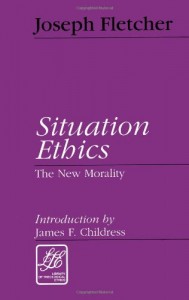
Book Review: Situation Ethics by Joseph Fletcher

As a personal quest to understand the field of ethics better, I picked up the book Situation Ethics by Joseph Fletcher at a local college library. This book seems to be the definitive guide on the matter of situation ethics as it began to infiltrate religious circles.

From everything I have been able to read about Joseph Fletcher and reading his book, I have determined that though he may have been a religious man, he certainly does not seem to have had a personal relationship with God. When he wrote this book in the late 1960s he was an Episcopal priest. He died a humanist and athiest. In the book it looks as though he believed Christianity was a good belief system around which to base one’s life, but was not necessarily something that changed his life.

book cover for Situation Ethics

The word legalist has been defined by different groups for different purposes. For Fletcher this would mean someone who holds to a set of laws and principles for moral decisions. By his definition I am a legalist. I believe that God has given us a book containing His absolute law and that there are many Bible principles we can use to guide our life and decisions.

Fletcher believes there is no law but love. He is talking about agape love. The type of love God has for mankind and that we should have for one another. The problem I have with his concept of love being the only guiding principle and that we each have to make the decision of what the most loving thing to do in any given situation is that it is completely arbitrary. Whatever you decide is the most loving thing in your situation is right according to Fletcher. In the book, and in life, he followed his beliefs to their only logical conclusion. He accepted the concept of abortion for any reason and the right to die (even committing suicide) if you decided it was the most loving thing to do. This would be morally acceptable and obligatory using the conclusions drawn in his book.

I cannot, as one who loves God and His Word, accept what Fletcher taught in Situation Ethics.

[Situation ethics] holds flatly that there is only one principle, love, without any prefabricated recipes for what it means in practice, and that all other so-called principles or maxims are relative to particular, concrete situations! If it has any rules, they are only rules of thumb. pg. 36

In other words, there are no absolutes. Nothing else in the Bible matters when a decision is being made: no laws, no commandments, no biblical principles.

Writing about the last five of the Ten Commandments he says:

But situation ethics has good reason to hold it as a duty in some situations to break them, any or all of them. We would be better advised and better off to drop the legalist’s love of law, and accept only the law of love. pg. 74

He sets forth 6 propositions that help the situationist make decisions. Look at these and see if they fit with a holy God who has given a law that brings us to an understanding of grace.

  1. Only one ‘thing’ is intrinsically good; namely, love: nothing else at all.
  2. The ruling norm of Christian decision is love: nothing else.
  3. Love and justice are the same, for justice is love distributed, nothing else.
  4. Love wills the neighbor’s good whether we like him or not.
  5. Only the end justifies the means; nothing else.
  6. Love’s decisions are made situationally, not prescriptively.

God has given us a law to follow. That is His Word–the Bible. And the Bible does speak to the point that love should be a guiding principle. It is found in Romans 13:10 “Love worketh no ill to his neighbour: therefore love is the fulfilling of the law.” In other words, love is doing what is right according to God’s laws. Fletcher says that love is doing what you personally decide is right without regard to any prescriptive laws. I must reject that.

It is unfortunate that the book is so expensive (currently $23 at Amazon). If you can get a copy at a library it would be worth reading if you are a student of ethics. Go into it with an understanding that Fletcher claimed to be a Christian at the time he wrote this book, however, he was not a Christian in the sense that he had a personal relationship with God and wanted to be obedient to the Word of God.

 Page 15 of 30  « First  ... « 13  14  15  16  17 » ...  Last »