Thursday, April 28th, 2011 at 12:18 am
Summary of the Book of Deuteronomy
Deuteronomy is a book containing four sermons that Moses gave to the people before entering the Promised Land. The events of the book took place over very few days prior to his death and the entering in to the land of Canaan.
The teachings of Moses in Deuteronomy are important enough to be quoted 90 times in 14 of the 27 books of the New Testament. When tempted by Satan in Luke 4, Jesus Christ quoted exclusively from the book of Deuteronomy (Deuteronomy 8:3; 6:13, 16).
The English title Deuteronomy comes from the Septuagint Greek version of the Old Testament. The word means “second law.” This is not a new law, rather a second telling, or re-telling of the law which was given in Mt. Sinai. The people living during the sermons in Deuteronomy were a new generation of Israelites who were not present when the Law was initially given to Moses 40 years before.
Author
Besides the fact that the book consists of the sermons of Moses, there are Old and New Testament references to Moses as the author. 2 Chronicles 25:4 refers to Moses as the author of the law written in Deuteronomy 24:16. Jesus quoted the book of Deuteronomy and attributed the writings to Moses (Matthew 19:7-9 compared to Deuteronomy 24:1-4; John 5:45-47 compared to Deuteronomy 18:15). Paul attributed the writing of the book to Moses in Romans 10:19 (compare with Deuteronomy 32:21).
While there are obvious proofs that Moses wrote the book, someone else had to have written the final chapter which contains the death of Moses. Most Bible scholars hold to Joshua and Ezra as the probable authors of that chapter. There are, however, biblical critics who claim (like Numbers) that the entire book was written several hundred years after Moses. Read the rest of this entry
Saturday, April 23rd, 2011 at 11:11 pm
Tonight I was talking with a Catholic friend who is very curious about my “religion.” She wanted to know what we do for Semana Santa (Holy Week) to celebrate Easter. At her church they have a special celebration on Palm Sunday and then throughout the week they have various displays and dioramas depicting the final week of Jesus.
I told her that we usually don’t celebrate the Passion Week with as much pageantry as the Catholic church does. Resurrection Sunday is where we place all the emphasis. The fact that Jesus rose from the dead and lives today is the focal point of all we celebrate in Christianity.
She is coming to our church’s Easter play tomorrow night in which we emphasize a Savior who came to the world for the sole purpose of dying on a cross in the place of sinners. Though Jesus Christ died on the cross to save us, He rose again to assure us of an eternal life in the presence of God the Father.
For us, it’s all about the resurrection.
Happy Easter!
Friday, April 15th, 2011 at 10:24 am
Bible study topics can be found in many different ways such as using a topical Bible or looking through Bible study guides. Another way to find a Bible study topic is to use a concordance.
A concordance is a type of reference work that helps you find Bible study topics based on certain words. You can look up a word in a concordance and see where the Bible mentions that word. Some concordances will also show variations of the word in the same listing. Don’t forget to look up synonyms for the word too. Concordances are also helpful if you remember certain words in a verse but can’t remember the reference. You can quickly find it by looking up the main words that you can remember of the verse.
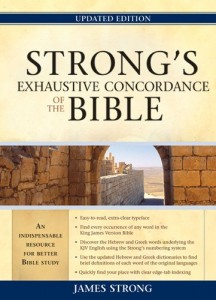 Many Bibles will have a concordance at the back after the main text. These are concise concordances. They don’t have every instance of every word; however, they usually have critical words. You can also buy a concise concordance in book form that is more complete than the one in the back of your Bible. It is also more convenient to have a separate book that you can reference while flipping through your Bible to the right verses.
An exhaustive concordance, like the Strong’s Exhaustive Concordance of the Bible, is much more comprehensive. This type of concordance will have every instance of every word in the Bible. Some have dictionary and lexicographical information in them. These will tell you the underlying Hebrew or Greek word that makes up the translated English word.
There are several websites which give you the same ability as a concordance. You are able to search for specific words through the whole text of the bible. Smartphone apps can do the same thing. One popular website for quick word lookups is Bible Gateway. It has many different Bible translations you can look through. The Blue Letter Bible website not only has the ability to look up words, but also ties every word to the Strong’s concordance numbers. There are Bible study tools which use those numbers to help with word studies.
A concordance is indispensable for pastors and teachers when preparing for their Bible study lessons. A concordance can also be a help to people wanting to do personal Bible study.
Wednesday, April 13th, 2011 at 11:03 pm
Summary of the Book of Numbers
Numbers gets its name from the two censuses, or numberings, of the people of Israel. The first was done shortly after the exodus. The second took place at the end of the 40 years in the wilderness as the nation was preparing to finally enter the Promised Land.
The majority of the book talks about the wilderness experience of the people of Israel. For this reason, the Hebrew title of the book is “In the Wilderness.” The Septuagint (Greek) translation of the book also calls it “Numbers” and is probably why it is called “Numbers” today.
Author
Like Leviticus, the book starts with God speaking to Moses. The book opens with: “And the Lord spake unto Moses.” This phrase (or variations) appear more than 80 times in the book. The authorship is most commonly attributed to be Moses (Numbers 33:1, 2). However, there are liberal scholars who believe the book was written by various priests during the post-Babylonian captivity. There is no hard evidence to suggest such a late writing for the book. Read the rest of this entry
Tuesday, April 12th, 2011 at 8:54 pm
I grew up hearing preachers talk all the time about studying your Bible. It seemed that so many emphasized that you should not simply read the Bible like you would any other book.
I felt guilty if I didn’t read my Bible. Then I would also feel guilty when I read it thinking that I wasn’t reading it slowly enough. Or, that I wasn’t doing Greek and Hebrew word studies as I read. All this talk about having to study the Bible (and not just read it) got me paranoid to think that whatever I did it would not be good enough.
Are you paralyzed with your Bible reading? Allow me to tell you that it is OK for you to read your Bible. If you want to take 3 months and study one word in the Bible, you are welcome to do that. If you want to read the entire Bible in a week, then that is fine too.
I think we have been told for far too long that reading your Bible like you would read any other book means that you are not spending time with God’s Word and you can’t really understand what it is saying. My question to those people is whether or not they can understand any other book they read. If they can, then they can probably understand the Bible just as well. And aren’t they going to read the Bible many times throughout their life? There are things they will see and learn the next time through.
Certainly there are times when extensive study is necessary and appropriate. But there are also times when getting a picture of what the whole Bible says at once will help you understand God’s Word more clearly. If you take 3 years to read through the Bible at one time, then you aren’t going to see the neat connection that the book of Hebrews has with the book of Leviticus. You can’t even remember where Leviticus was by the time you get to Hebrews.
Enjoy God’s Word at whatever pace you need to so that you can be brought into better fellowship with Him.