Archive for February, 2012

The Law of Sowing and Reaping

Sowing and Reaping Principle

[pullquote] Be not deceived; God is not mocked: for whatsoever a man soweth, that shall he also reap. For he that soweth to his flesh shall of the flesh reap corruption; but he that soweth to the Spirit shall of the Spirit reap life everlasting. And let us not be weary in well doing: for in due season we shall reap, if we faint not.

—Galatians 6:7-9[/pullquote]

When we think about sowing and reaping, a topic the Bible actually covers quite a bit, we are prompted to think about the physical world even though the Bible is speaking of spiritual things. God’s promise is that we will reap. This can be either good or bad, depending on what it is you are sowing.

You Reap What You Sow

If you plant corn, you reap corn. No one expects to plant green beans and have carrots sprout up. However, we tend to think that we can sin and do wrong and still reap good things.

This does not have to be negative though. These verses are nestled into a beautiful passage of verses (1-10) that talk about doing good and serving others. The result is a promise that you will reap after the same kind as you sow.

You Reap More Than You Sow

This is the part of the law of sowing and reaping that can either excite you are scare you. Obeying God and serving Him can result in some wonderful blessings. I am not advocating a “name it and claim it” type religion, but God does promise that you will reap more than you sow (Matthew 25:14-30).

This is a natural principle. The farmer who plants one kernel of corn does not expect a single kernel to pop up. No, he expects a whole stalk with several ears which have hundreds of kernels of corn on them.

You Reap in Proportion to What You Sow

Beyond reaping more than you sow, you also reap proportionately to what you sow. If you sow one seed for a bean stalk you can expect dozens or hundreds of beans. But if you plant 10 you can expect a to reap 10 times more than if you only planted one. That is natural in the law of sowing and reaping.

You Reap Later Than You Sow

As a young boy I remember we planted a garden each year. I got excited to think about all the little veggies growing in the field. I had hoped to see new growth every day. I also grew impatient at times when the garden progressed so slowly. But an experienced farmer knows that the harvest doesn’t happen overnight. It takes weeks for some crops, months for others and can even take years for other kinds of crops to mature for the harvest.

However long it takes, the law of sowing and reaping indicates that the harvest comes at a later time. We will reap if we continue to sow.

How’s Your Garden?

Are you sowing good seed? Remember you will reap what you sow, more than you sow, later than you sow and to a greater proportion than what you sow.
The cloke that I left at Troas with Carpus, when thou comest, bring with thee, and the books, but especially the parchments.

—2 Timothy 4:13

Going through some of my Bible college notes I came across a list of books we were told we should have for a well-rounded library of Bible study tools. Today you can get much of this material online and in Bible study software. But it is nice to pull a book off the shelf and flip through the pages while studying–especially if you have to go back and forth between pages looking for connections between concepts. Most reference books you wouldn’t want to read cover to cover, but there are a couple that would make great devotional material for someone more serious about Bible study.

Here is the list with Amazon links. Obviously Amazon is not the only place you can get these. See if your local Bible bookstore has them so that you can browse through the pages and see if you really want or need the book. Some of these titles have Kindle editions available for them. For the multi-volume sets the Kindle version might be better since you can easily search for the information without pulling 25 lbs. worth of books off your shelf.

Though it wasn’t on the list I got in school, one of my favorite Bible handbooks is Halley’s Bible Handbook.

If you are interested in building a lasting library, look for hardback versions of these books. For the Bibles, the hardback version will be cheaper than leather covers–even bonded leather. They won’t get beat up as easily either.

I hope this list helps you get started in serious Bible study. If you have a book that you recommend either in place of one of the books listed or in addition to the list, leave a comment below and share it with the other readers. I am curious as to what others are recommending in the 20+ years since this list was given.

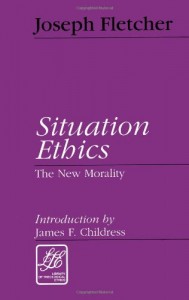
Book Review: Situation Ethics by Joseph Fletcher

As a personal quest to understand the field of ethics better, I picked up the book Situation Ethics by Joseph Fletcher at a local college library. This book seems to be the definitive guide on the matter of situation ethics as it began to infiltrate religious circles.

From everything I have been able to read about Joseph Fletcher and reading his book, I have determined that though he may have been a religious man, he certainly does not seem to have had a personal relationship with God. When he wrote this book in the late 1960s he was an Episcopal priest. He died a humanist and athiest. In the book it looks as though he believed Christianity was a good belief system around which to base one’s life, but was not necessarily something that changed his life.

book cover for Situation Ethics

The word legalist has been defined by different groups for different purposes. For Fletcher this would mean someone who holds to a set of laws and principles for moral decisions. By his definition I am a legalist. I believe that God has given us a book containing His absolute law and that there are many Bible principles we can use to guide our life and decisions.

Fletcher believes there is no law but love. He is talking about agape love. The type of love God has for mankind and that we should have for one another. The problem I have with his concept of love being the only guiding principle and that we each have to make the decision of what the most loving thing to do in any given situation is that it is completely arbitrary. Whatever you decide is the most loving thing in your situation is right according to Fletcher. In the book, and in life, he followed his beliefs to their only logical conclusion. He accepted the concept of abortion for any reason and the right to die (even committing suicide) if you decided it was the most loving thing to do. This would be morally acceptable and obligatory using the conclusions drawn in his book.

I cannot, as one who loves God and His Word, accept what Fletcher taught in Situation Ethics.

[Situation ethics] holds flatly that there is only one principle, love, without any prefabricated recipes for what it means in practice, and that all other so-called principles or maxims are relative to particular, concrete situations! If it has any rules, they are only rules of thumb. pg. 36

In other words, there are no absolutes. Nothing else in the Bible matters when a decision is being made: no laws, no commandments, no biblical principles.

Writing about the last five of the Ten Commandments he says:

But situation ethics has good reason to hold it as a duty in some situations to break them, any or all of them. We would be better advised and better off to drop the legalist’s love of law, and accept only the law of love. pg. 74

He sets forth 6 propositions that help the situationist make decisions. Look at these and see if they fit with a holy God who has given a law that brings us to an understanding of grace.

  1. Only one ‘thing’ is intrinsically good; namely, love: nothing else at all.
  2. The ruling norm of Christian decision is love: nothing else.
  3. Love and justice are the same, for justice is love distributed, nothing else.
  4. Love wills the neighbor’s good whether we like him or not.
  5. Only the end justifies the means; nothing else.
  6. Love’s decisions are made situationally, not prescriptively.

God has given us a law to follow. That is His Word–the Bible. And the Bible does speak to the point that love should be a guiding principle. It is found in Romans 13:10 “Love worketh no ill to his neighbour: therefore love is the fulfilling of the law.” In other words, love is doing what is right according to God’s laws. Fletcher says that love is doing what you personally decide is right without regard to any prescriptive laws. I must reject that.

It is unfortunate that the book is so expensive (currently $23 at Amazon). If you can get a copy at a library it would be worth reading if you are a student of ethics. Go into it with an understanding that Fletcher claimed to be a Christian at the time he wrote this book, however, he was not a Christian in the sense that he had a personal relationship with God and wanted to be obedient to the Word of God.

Bonhoeffer on the Bible

Dietrich Bonhoeffer was a German theologian in the early 20th century. He is most remembered for his imprisonment and execution for his involvement in a plot to assassinate Adolph Hitler. Theologically he was an amazingly conservative man considering the environment he studied in.

I am reading the recent biography about Bonhoeffer written by Eric Metaxas, Bonhoeffer:  Pastor, Martyr, Prophet, Spy. By the time Bonhoeffer was 21 years old he had already earned a doctorate in theology. However, it wasn’t until he was 26 that he actually fell in love with the Bible. Before this he approached the Bible as something to be studied for the purpose of understanding God in a logical, organized fashion. However, all that changed when he started reading the Bible for the purpose of letting God’s Word communicate to him and change his life.

Here is what he had to say to his brother-in-law in a letter concerning the Bible:

First of all I will confess quite simply—I believe that the Bible alone is the answer to all our questions, and that we need only to ask repeatedly and a little humbly, in order to receive this answer. One cannot simply read the Bible, like other books. One must be prepared really to enquire of it. Only thus will it reveal itself. Only if we expect from it the ultimate answer, shall we receive it. That is because in the Bible God speaks to us. And one cannot simply think about God in one’s own strength, one has to enquire of him. Only if we seek him, will he answer us. Of course it is also possible to read the Bible like any other book, that is to say from the point of view of textual criticism, etc.; there is nothing to be said against that. Only that that is not the method which will reveal to us the heart of the Bible, but only the surface, just as we do not grasp the words of someone we love by taking them to bits, but by simply receiving them, so that for days they go on lingering in our minds, simply because they are the words of a person we love; and just as these words reveal more and more of the person who said them as we go on, like Mary, “pondering them in our heart,” so it will be with the words of the Bible. Only if we will venture to enter into the words of the Bible, as though in them this God were speaking to us who loves us and does not will to leave us along with our questions, only so shall we learn to rejoice in the Bible.

. . .

And I would like to tell you now quite personally: since I have learnt to read the Bible in this way—and this has not been for so very long—it becomes every day more wonderful to me. I read it in the morning and the evening, often during the day as well, and every day I consider a text which I have chosen for the whole week, and try to sink deeply into it, so as really to hear what it is saying. I know that without this I could not live properly any longer.

I have seen the transition in friends of mine who have previously approached the Bible as a textbook and then later saw the Bible as God communicating with them personally. It changed their life. I am thankful that this approach to the Bible (God’s Word written for man’s understanding) was taught to me from the time I was saved as a young man.

I am only partially through the Bonhoeffer book, but I plan to give a full review when I finish it. I am reading the Kindle version which is a lot lighter than 1.8 pound hardback version.