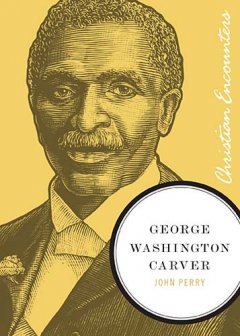
 Like most kids growing up in a Christian school I had to read a little bit about George Washington Carver as part of my education. However it has been many years since I read about this great scientist and Christian. I was excited for the opportunity to read about Dr. Carver again. Thomas Nelson has a new series called the Christian Encounters Series in which they have biographies of great Christians of the past. I had not read any of these books before, but will likely read more based on this title.
This biography focused on two things that shed some interesting light on the man and the time period. First was his relationship with Booker T. Washington. The second was his view of the scientific method. With those two items the author wove in some of the socio-political environment that surrounded the time.
Booker T. Washington was the man who started the great school in Tuscaloosa, Alabama where Dr. Carver spent the majority of his career as a teacher and researcher. While these two men worked with each other for many years, they had a rough personal relationship. They both had common goals, but their approach was completely different on how to achieve those goals. This brought tension in their day-to-day work environment. It seemed Carver tendered his resignation a couple of times each year while Washington was still alive. Washington never accepted the resignation letter because he knew that he was completely dependent on Carver and what he added to the school. They had a mutual respect for one another and publicly spoke highly of the other man. However, privately they seemed to struggle and were constantly frustrated with the actions of the other.
Carver believed that God revealed to him what facets of research he should be engaged in. Because of this, he did not have any regard for the scientific method (the idea that a scientist would document each variable in his research so that he could know what did and did not produce the results that were seen). Since Carver did not take exhaustive notes of his research, he had to rely on intuition and past experience to know what caused the results. This was not because of laziness on his part. He honestly believed that if one was in tune with God and His leading, then God would reveal and guide the scientist to the right answers. Carver understood the scientific method, but he believed it was an un-Christian way to do research.
For all the good points Dr. Carver had, he seemed to be overly focused on recognition for his accomplishments. He would rather have someone publicly recognize his achievements as opposed to give him large sums of money for his work. This need for public recognition was much of what caused the tension between him and Washington. Money meant nothing to him. In fact, he saved virtually every dollar he earned and gave it away to different causes towards the end of his life.
The book is well written and moves the story along. While not everyone is looking for a quick read, I personally like an overview-type biography. This book is just 176 pages. Though I have not read any books by John Perry, I am interested in other books he has written in the Christian Encounters Series.
George Washington Carver by John Perry. Thomas Nelson 2011.
[Disclosure: I received a free review copy of this book.]